
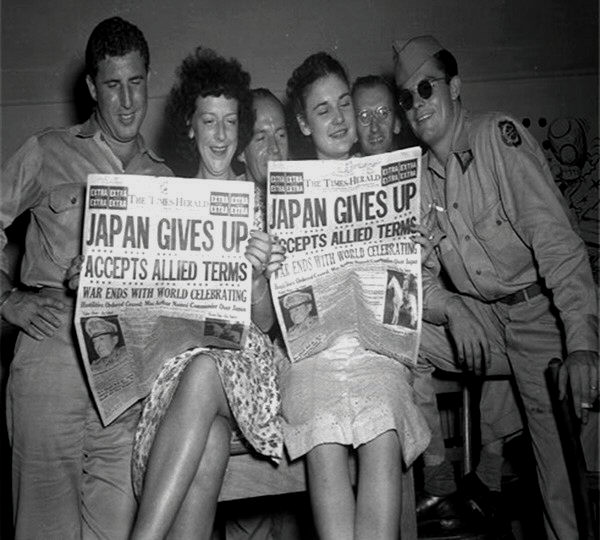
The surrender of Germany on May 8, 1945, marked the beginning of the end of World War II, but VJ Day – shorthand for victory in Japan – was the end of it all. Eighty years ago this week, after U.S. planes dropped atomic bombs on the cities of Hiroshima and Nagasaki on August 6 and 9, respectively, the war in the Pacific theater came to an end with Emperor Hirohito announcing Japan’s unconditional surrender on August 14, 1945 – which was actually August 15 for those in the Western Hemisphere who were following the news.
The formal surrender took place a couple weeks later on September 2 on the deck of the USS Missouri in Tokyo Bay, in accordance with the Potsdam Declaration drafted in late July by U.S. President Harry Truman, British Prime Minister Winston Churchill and Chinese President Chiang Kai-Shek.
The photos and headlines from mid-August capture the jubilation, but the final victory came at a high price. Nearly 417,000 American soldiers died during World War II. About 292,000 of those were combat deaths and the remainder were deaths by other causes, such as accidents or disease. The estimated civilian death toll worldwide ranges from 40 to 50 million.
We ended it by creating and deploying the most powerful and destructive weapon known to man. We had let the nuclear genie out of the bottle, and the Soviet Union responded in kind by successfully detonating an atomic bomb of their own in 1949. The possibility of global self-destruction had become an unsettling reality, and the result was a Cold War that persisted for four decades.
On the more optimistic and proactive side, we took definitive steps to ease the post-war tension and lay the groundwork for a peaceful future. By 1948, we had established a plan to help rebuild Europe. A year later, we joined a dozen other countries in the establishment of NATO, an alliance of western nations committed to protecting each other against any future aggression by an external superpower. (The number of participating nations has since grown to more than thirty.)
In short, everything changed – not just in the immediate aftermath of the war, but for the entire second half of the century and beyond.
My father was just a couple months shy of his thirteenth birthday when the United States entered the war immediately after the Japanese attacked Pearl Harbor at the end of 1941. I tend to think of that Day of Infamy and everything that followed for the next four years as his coming-of-age story – as it likely was for so many Depression-era babies like him. At home, everything was about the war effort – rations, scrap drives, countless sacrifices large and small. He spent most of his teenage years following every newspaper and radio report from Europe and the Pacific. He studied every military campaign. He could identify every Allied and Axis aircraft in the sky anywhere around the world. He was a walking encyclopedia of all things World War II. He could retell the whole story from 1939 to 1945 without a single note card.
He still talked about it when I was growing up, but I didn’t give it much thought at the time. It was a chapter of history that came to an end nearly two decades before I was born. For most of the 1970s, I lived a life of television, B movies, comics and relative comfort. World War II was just a thing that had happened a long time ago.
But it seems more real now. Somehow more immediate, even eighty years after it ended. These days, every hellish image of the USS Arizona at Pearl Harbor, every harrowing account of Normandy Beach on D-Day, every glimpse of the famous flag-raising photo at Iwo Jima, every grainy film of the Enola Gay takeoff gives me pause. The sweep of history – and the decisions and sacrifices that are part of it – can be hard concepts for a twelve-year-old kid in a middle-class suburb to understand, but they can mean a lot more when that kid gets older. Or they should, anyway.
A former colleague during my newspaper days – a post-war boomer born in 1950, and a writer with a keen sense of history and human nature – made an assertion sometime around the turn of the new century that has stuck with me for twenty-five years. He said most people failed to grasp the idea of two separate worlds – the one that existed prior to World War II and the one that has existed since. Neither he nor I experienced any of it first-hand, but we’d both spent our entire lives hearing its persistent echo.
The cohort often referred to as The Greatest Generation is gone. For that matter, many of their younger siblings and children who held vigil on the home front are also slipping away. Our connection to what Studs Terkel called The Good War grows more tenuous every year. The 21st century is largely in the hands of people who are at least a couple generations removed from it all, not unlike that twelve-year-old suburban kid in the ‘70s for whom World War II was just a thing that happened a long time ago.
It’s hard to know how much longer the echo will last, or how many more ears it will reach before it fades completely.
I choose to keep listening.