
Film noir is like any other creative aesthetic or artistic movement. The closer the examination, the more difficult if not impossible it becomes to define exactly what it is or exactly when or where it started. I’ve said the same about music in the past. Fill a room with ten jazz fans, for example, and tell them to come up with a definition for the genre, and you’re likely to get a fistfight long before you get anything that looks like a definition.
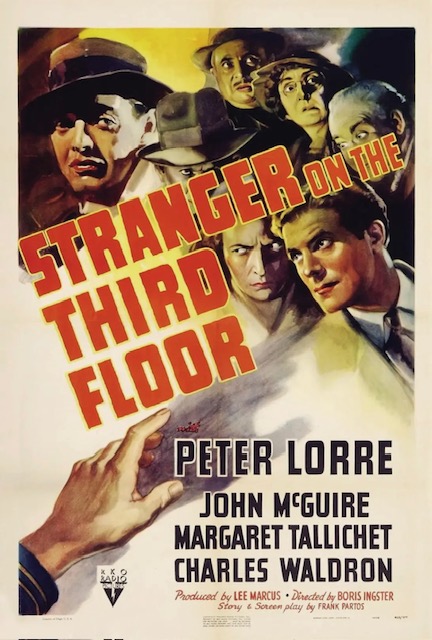
Stranger on the Third Floor (1940) is often referred to as the first true film noir because director Boris Ingster used certain techniques that later became conventions of the genre: consistently dim lighting, long shadows, and expressionistic set designs (especially in a lengthy and over-the-top dream sequence).
The designation of “first” makes sense to me in the context of what is considered the classic period of film noir, which most historians bracket between 1940 and 1959. But there are several crime dramas from the 1930s and even earlier that I would also consider film noir. Little Caesar (1931), Scarface (1932), and I Am a Fugitive from a Chain Gang (1932) are all prominent examples.
But if Stranger on the Third Floor – Ingster’s directorial debut – is indeed the cinematic big bang of the classic period, it has reached a milestone anniversary of sorts. The film opened in theaters nationwide 85 years ago this week, on August 16, 1940.
It’s the story of an ambitious young newspaper reporter named Michael Ward (played by John McGuire), who is the key witness in a murder trial that results in the death sentence for the accused, Joe Briggs (Elisha Cook, Jr.). But the tables are suddenly turned when the reporter’s neighbor (Charles Halton) is found dead shortly after the trial and Ward himself is suddenly a prime suspect for murder. Peter Lorre is the nameless title character, who spends most of the movie skulking around hallways and stairways in the reporter’s apartment building, stealing every scene with his trademark bulging eyes and shifty expressions.
The story itself is kind of weak, but it doesn’t eat up too much time (64 minutes) and it’s visually compelling. In fact, “it looked radically new” in comparison to the crime and horror films of the 1930s, according to Jeremy Arnold of TCM.com. “Its extraordinary look and tone are the product of stylized sets, bizarre angles and lighting, and a powerful blurring of dream and reality – qualities strongly influenced by German expressionist films of the 1920s.” (Two of the most prominent filmmakers from this earlier period were Fritz Lang and F.W. Murnau, who were already establishing the most basic visual elements of film noir in the silent era.)
Arnold gives much of the credit for the film’s visual impact to its art director, Van Nest Polglase, who had previously worked on King Kong (1933) and The Hunchback of Notre Dame (1939). Polglase would also work on Citizen Kane, which was released a year after Stranger on the Third Floor.
For all the film’s visual innovation, it faced some headwinds from critics – not only at the time of its release, but also in more recent years. In a 1940 review, Bosley Crowther of The New York Times said the characters of Ward and his girlfriend Jane (played by Margaret Tallichet) are reasonably drawn, “but in every other respect, including Peter Lorre’s brief role as the whack, it is utterly wild. The notion seems to have been that the way to put a psychological melodrama across is to pile on the sound effects and trick up the photography.”
Seventy-five years later in 2015, Dave Kehr of The Chicago Reader called the film “absurdly overwrought (which was often the problem with the German variety), but interesting for it.” He added that Ingster “is better with shadows than with actors – venetian blinds carve up the characters with more fateful force than Paul Schrader’s similar gambit in American Gigolo, and there’s a dream sequence that has to be seen to be disbelieved.”
Then again, it’s not uncommon in classic film noir for things like story structure and character development to take a back seat to less tangible elements. The emphasis on atmosphere is a hallmark of some of the best movies in the genre. If Stranger on the Third Floor is indeed the first that many claim it to be, it’s entitled to a few flaws. The early steps in any artistic movement – especially by a first-time director – are bound to be tentative and wobbly.
In the end, maybe the most satisfying approach is to just refrain from overthinking, embrace the dark and ominous vibe, and enjoy this early offering in a classic form of cinematic storytelling positioned squarely in the middle of the 20th century.
But watch out for that creepy, bug-eyed guy lurking in the stairwell.