
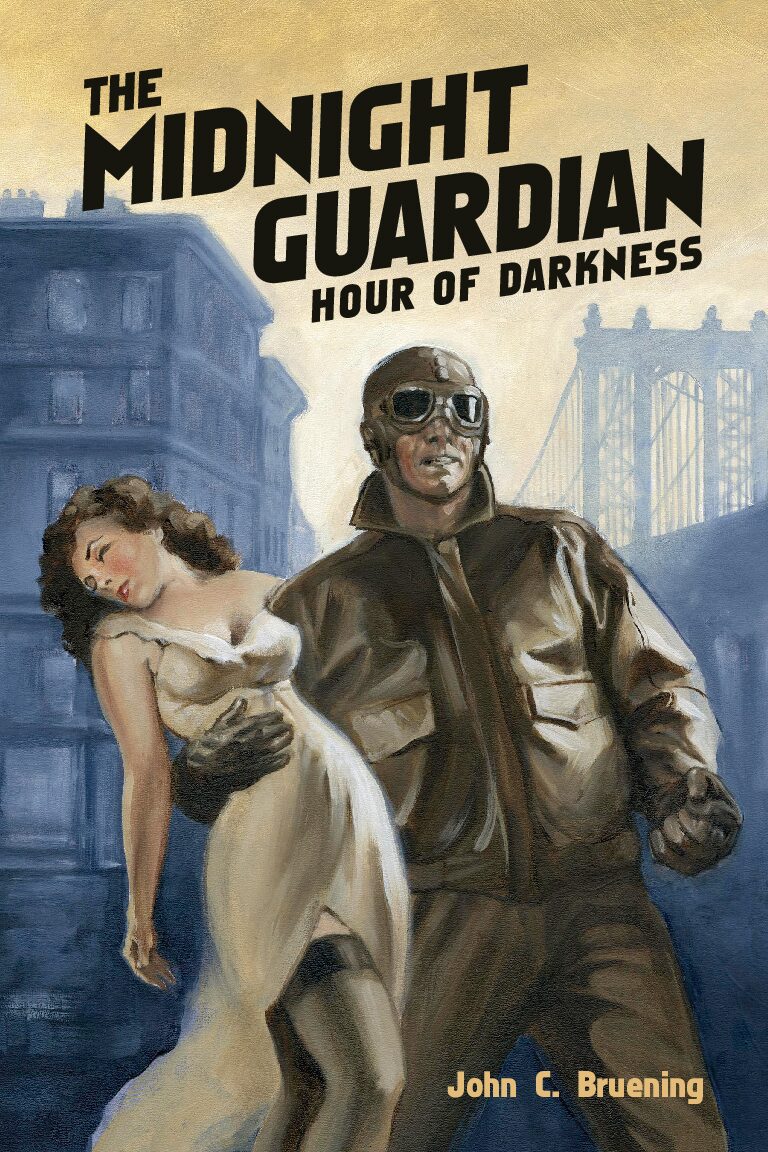
Ten years ago today, I held my breath, threw the switch, and released my debut novel, The Midnight Guardian: Hour of Darkness. Set in 1936, it’s the story of a masked vigilante who takes on a sociopathic crime lord in a fictional metropolis called Union City. Part crime story and part swashbuckling adventure, it was conceived and written in the spirit of the classic pulp fiction of the 1930s and ‘40s.
This masked man’s secret weapon is the mask itself. Advanced electrical circuitry woven into the inner lining stimulates various nerve centers in his brain, heightening his senses and sharpening is reflexes, enabling him to see in the dark and respond to danger with superhuman speed and clarity.
Hour of Darkness was published by a fledgling small press called Flinch Books, the small two-man operation that I co-founded the year before with fellow writer/editor/Ohioan and friend Jim Beard.
It’s hard to know exactly when the writing started. The earliest handwritten notes go back to somewhere around 2008. At the time, I had only the vaguest idea of what I was doing. I understood the basic three-act structure that novelists and other storytellers have used for centuries. I had a general idea of what makes characters likeable, unlikeable, sometimes both, and generally interesting. And I had a good ear for dialogue, thanks in part to the fifteen years I had spent as a journalist several years earlier in my career.
More broadly, I wanted to tell a pulp story, but I wanted to infuse it with enough depth and sophistication to hold the attention of a 21st century reader. Beyond that, I didn’t know much else. I had no idea where the thing might land when I finished – if anywhere, if I finished it at all.
I had already familiarized myself with the works of Dashiell Hammett and Raymond Chandler, two of the primary architects of the hardboiled detective fiction of the 1930s. And I had just started to dive into a pile of Doc Savage paperbacks from the 1960s – reprints of Doc’s original pulp adventures from the 1930s – that I had found in a local indie bookstore.
There were other influences too – a rich stew of ingredients and raw materials that had been simmering in the recesses of my consciousness since I was six or eight years old. They included (in no particular order): The Green Hornet in his various radio, serial and TV iterations; The Untouchables (primarily the 1987 Brian DePalma film, but also the classic television series of the same name that ran from 1959 to 1963); Ed McBain’s long-running series of 87th Precinct novels; Spy Smasher, a 1942 Republic serial based on a popular comic book character from the same era); and the classic gangster movies and film noir of the 1930s and ’40s.
That’s the short list, anyway. There’s plenty more, but like any good cook, I choose to keep some of the ingredients a secret.
The early pages didn’t exactly come fast and furious. There were other demands on my time. The writing came in fits and starts, followed by several weeks in a drawer, followed by more fits and starts, etc. I didn’t even know Jim Beard at the time. All I knew was that I had embarked on a type of story – and a type of storytelling – that had fallen out of fashion with mainstream readers and publishers sixty or seventy years earlier.
After a few brief encounters with Jim at the annual Pulpfest convention (which took place in Columbus in those days), he approached me pretty much out of the blue in late 2014. He was starting a small publishing venture at the time, and quickly discovering that it was consuming more of his bandwidth than he had expected – and more than he could manage on his own. He asked if I’d be interested in partnering with him to share the workload.
I hesitated a little at first, but then he made me the offer I couldn’t refuse: If I had any novels, short stories, or other fiction that I was working on, this could be a platform to publish it.
Sold.
We officially launched Flinch Books in January of 2015, and I spent the next twelve months finishing the book. Somewhere in that time, I commissioned Chicago-based artist Thomas Gianni to illustrate the cover. Tom delivered an image that perfectly captured the tone and the period of the story I wanted to tell. Unfortunately, that first cover would be our only project together. Tom passed away in 2020 after a long bout with cancer. (Doug Klauba, a gifted artist who also hails from Chicago, has seamlessly picked up where Tom left off.)
I honestly didn’t know what to expect when we published the book, but in the weeks and months that followed, the responses were generally favorable. Sometimes extremely favorable. Nearly every one of the Amazon readers who weighed in did so with at least four stars and plenty of kind words and support. Even now, ten years later, a new review occasionally shows up on the platform. Apparently it’s a book with legs.
A few writers I know and admire have also given it a favorable nod. Edgar Award nominee Craig McDonald, author of the Zana O’Savin and Hector Lassiter series, called it “a terrific, atmospheric, character-driven, smart and loving evocation of iconic pulp-style storytelling.”
William Patrick Maynard, author of a new series of Fu Manchu novels sanctioned by the estate of Sax Rohmer, called Hour of Darkness “the creative construct of a first-rate storyteller” in a glowing review on Blackgate.com a couple months after the book was published. I’m forever grateful to Bill for his ability to grasp exactly where I was coming from when I wrote it.
March of the Giants, the next installment in the Midnight Guardian saga, will be published before the end of 2026. In a span of ten years and soon-to-be four books, the mysterious masked avenger of Union City has developed a modest but consistent following. He’s introduced me to some great people and helped open doors to opportunities that I never would have expected to come my way.
If you’re reading these words, there’s a good chance that you’ve been on some part of this ride with me. Maybe all of it. Whenever and wherever you got on board, I’m grateful to have you here. So is The Midnight Guardian.
Stay tuned.