
I only remember a small sliver of the 1960s—the last couple years of the decade, which was a time of unrest. Prominent national leaders were being assassinated, a war in Southeast Asia was escalating, and the ongoing clash between the establishment and the counterculture was becoming more volatile every week.
And yet there was somehow an optimistic dimension too. We’d fixed our sights on a place beyond this world. We had committed ourselves to putting a man on the moon by the end of the decade and we had established a national space program that was prepared to do whatever it took to get there.
The U.S. space program and the race against the Soviets to reach the moon had become part of the fabric of our Cold War culture. Astronauts in NASA’s Mercury, Gemini and Apollo programs were celebrities. The names for various bits of rocket hardware had become part of the mainstream lexicon. Hell, the Ford Motor Company introduced an affordable family car called the Galaxie—and my parents had one parked our driveway.
Perhaps the best part of all, space was on our TV screens in network primetime.
Before I could work my way up to warp speed, I had to start slow. My earliest memory of space adventure on our black and white Zenith television set was a group of intrepid explorers—a mom, a dad, and their three kids, collectively known as the Robinsons. Lost in Space was ideal for a wide-eyed five-year old. It was a series that didn’t ask too much of its viewers, especially in its second and third seasons, when the intriguing original premise of a family in space morphed into something campy and absurd.
But there was that other show, the one on the other network. That was something altogether different. That was something for the big boys.
That was Star Trek.
I was barely aware of Star Trek during its initial network run. I was not quite three years old when it premiered sixty years ago this week in September of 1966, and I was five-and-a-half when the last episode aired in June of 1969. I didn’t stumble upon the series until it was in syndicated reruns a couple years later in the early 1970s.
Even then, my first experience of Star Trek was in bits in pieces. I’d catch five minutes of one episode here, ten minutes of another episode there. The language and the subject matter were extremely sophisticated, the characters were intelligent and multi-dimensional, the situations often felt deadly serious, and the starship on which many of the stories took place looked absolutely glorious. I remember my very young mind thinking, “I can’t really grasp what’s going on here, but this is just about the coolest thing I’ve ever seen on TV.”
I barely understood the basic premise or the relationship between the main characters, but there were certain isolated scenes and scenarios that grabbed me, maybe even scared me a little, and stuck in my memory. The original Star Trek series was a hell of a lot for a young kid in the early ‘70s to process. But it was—to coin a phrase—fascinating.
Somewhere around the fourth grade, a classmate at my Catholic elementary school—a kid named Steven who was way smarter than me or anyone else in our class, and probably a few of our teachers too—lent me a book called The Making of Star Trek, written by Stephen Whitfield and series creator Gene Roddenberry. It was published in 1968, when the show was still in its original prime-time run—after the famous fan letter campaign that convinced the network to keep it on the air for a third season. So now I not only had a friend who could help me make sense of the episodes themselves, I had a book that took me behind the scenes and showed me how the series was conceived and how it got on the air every week less than a decade earlier.
And that’s when I finally got into high gear with Star Trek. I started watching the reruns—in their entirety for the first time, beginning to end, every weeknight on the local independent station.
The adventures were certainly perilous and entertaining, but I realized pretty quickly that there was something else going on under the surface. For every alien menace and sleek bit of 23rd-century gadgetry deployed to confront it, there was also a very human component to every story (and I use the word “human” in the figurative sense in this context). At the heart of all the intergalactic drama were thought-provoking questions about logic and reason versus ignorance, cultural harmony versus prejudice and disunity, diplomacy versus violence, and the perseverance of humanity amid the march of technology.
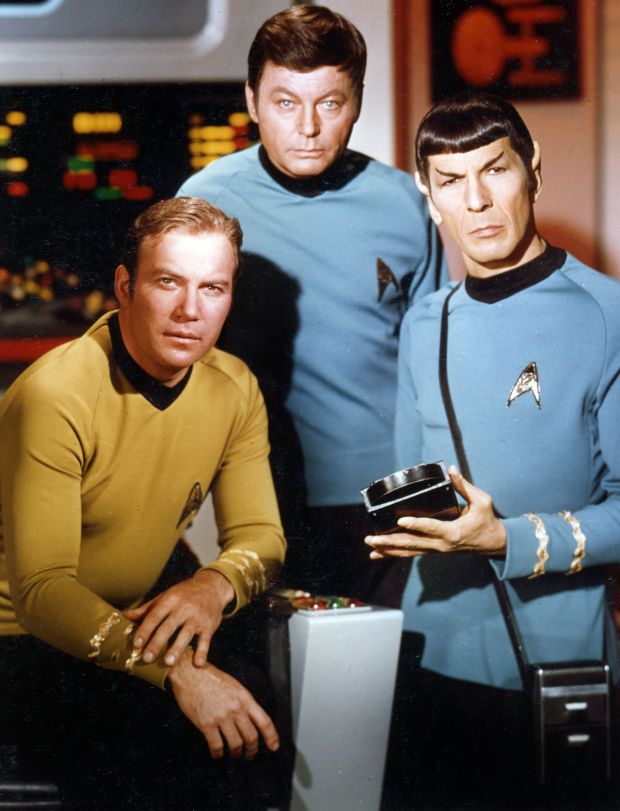
But the thing that attracted me even more—and still does to this day—was the chemistry of the recurring characters: A youthful and unflinching starship captain, full of piss and vinegar and possessed of a spine made of pure steel. A stoic first officer, not of this world and seemingly devoid of emotion, with a razor-sharp intellect that often proved to be a powerful weapon. A curmudgeonly chief medical officer, whose assessment of himself as “a simple country doctor” belied his true abilities as a gifted healer. A black female communication officer. (Read that again: A black female officer. Sitting just over the captain’s right shoulder in a command center otherwise populated by men. In 1966.) A Scotsman in the engine room. An Asian navigator. A Russian helmsman.
The crew of the USS Enterprise was as magnificent looking as the ship itself, a mosaic of the best that this or any other world had to offer.
Star Trek was a groundbreaking slice of pop culture entertainment. Roddenberry was doing something unheard of, going boldly where no television creator had gone before and dressing up his handiwork in a futuristic and adventurous setting that made it safe for prime time. And in syndicated reruns just a few years later, it was still an enlightening experience for this fourth grader.
I can’t say I was a died-in-the-wool Trekkie—or Trekker, or whatever the hardcore fans call themselves—by the time I finished grade school, but the original Star Trek series had gotten under my skin in a way that I had yet to realize over the next few decades. Even now, I’m still drawn to those original 79 episodes of Star Trek.
The franchise has since been reinvented and spun off at least a dozen times, on small screens and big ones. In the process, it has become an industry unto itself. I’ve dialed in to some of the various newer iterations for a brief glimpse, and it all has a certain undeniable appeal—artistically as well as technically—but none of it has had that same I-can’t-even-comprehend-what-I’m-seeing-but-I-can’t-look-away effect that I experienced in the old days. That’s the kind of experience you only get when you’re ten or twelve years old and the world is still an unexplored galaxy. Once you transition out of that chapter of your life, it’s very hard to go back.
But every once in a while, I’ll stream an episode or two of the original series. When I do, I might chuckle a little bit at William Shatner’s occasionally ham-fisted portrayal of the blustery Captain James T. Kirk. Or Leonard Nimoy’s raised eyebrow that conveyed so much that the tightly wound Mr. Spock would never allow himself to say out loud. Or the alien terrains littered with boulders that were obviously nothing more than carefully painted lumps of Styrofoam scattered across a sound stage. Or the creaky visual effects that predated CGI technology by at least a couple decades. Or the tragic but predicable fate of nearly every red-shirted crew member who appeared on camera. Or the number of times DeForest Kelley as Dr. Leonard “Bones” McCoy examined a body in the first act and informed his commanding officer in his grim and raspy voice, “He’s dead, Jim…”
But if I chuckle at all, it’s only for a moment or two. It’s easy to look past all that stuff when you can see what Roddenberry and his cast and crew were aiming for, the bigger picture they were trying to paint, the greater story they were trying to tell. After the first few minutes, sixty years after star date 9/8/1966, I find myself back on the five-year mission, once again going as boldly as I can.
And it’s still fascinating.
# # #
(This post is an edited and abridged version of an essay that originally appeared in Galloping Around the Cosmos: Memories of TV’s Wagon Train to the Stars from Today’s Grown-Up Kids, edited by Jim Beard and published by Becky Books in 2023. The book is a collection of retrospective essays from twenty-five writers about the original Star Trek television series.)