
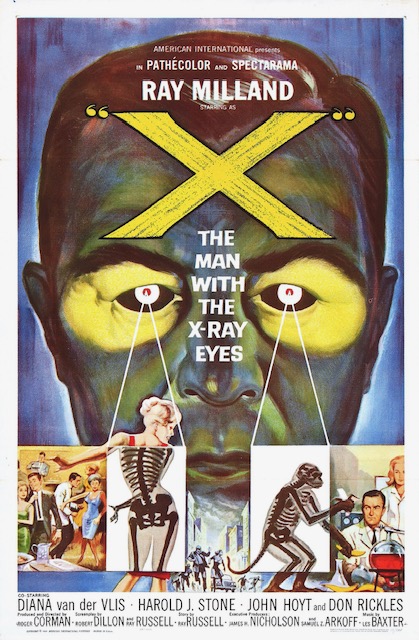
Somewhere during my middle school years in the mid-1970s, I started dialing in to the late-night sci-fi/horror movie of the week that the CBS affiliate in Cleveland (WJW, Channel 8) aired every Friday night after the eleven o’clock news. I was probably twelve or thirteen the first time I saw X: The Man with the X-Ray Eyes, a cult classic from 1963 directed by Roger Corman and starring Ray Milland in the title role. The story follows the ill-fated trajectory of James Xavier, a scientist who experiments with a new drug he’s developed to expand the range of human vision to recognize the ultraviolet and x-ray wavelengths.
Xavier administers the drug to himself, but as we all know from countless other horror and sci-fi films over the course of nearly a century, things never end well when man tampers with the laws of nature. Such is the case with Xavier, whose enhanced vision starts out as a great gift but gradually devolves into a deadly curse. Over time, his continued use of the drug exposes him to dimensions of the universe that his mind can’t comprehend. His judgment is compromised, his darker impulses take over, and bad things happen.
At the end of his rope, Xavier stumbles into a fundamentalist tent revival in the Nevada desert in search of salvation. Only in the last seconds of the final scene is he able to rid himself of his affliction once and for all – by rather ghastly means.
What I didn’t know when I saw X: The Man with the X Ray Eyes that first time was that I was watching a film directed by one of the most successful and influential independent filmmakers of the late 20th century. Roger Corman was not only a director, but also a screenwriter, producer and distributor. And he occasionally appeared in front of the camera in films directed by his peers and his protégés.
Capturing the scope of his influence on post-World War II filmmaking in just a few hundred words isn’t possible. Born 100 years ago in Detroit, Michigan, on April 5, 1926, he started his career as a messenger in the mailroom at 20th Century Fox. After two years in the Navy from 1944 to 1946, he returned to the film business in Los Angeles and took small jobs around the edges of screenwriting and production. He wrote a story after-hours that became the basis for Highway Dragnet, a 1954 feature-length film directed by Nathan Juran, who shot it in just ten days. The cast included Richard Conte and Joan Bennett.
Corman used the $12,000 he made from the sale of his story to fund the production of Monster from the Ocean Floor, a science fiction film directed by Wyott Ordung and released later that same year.
Over the next sixty-five years, Corman directed or produced more than 500 low-budget feature films representing a range of genres that included science fiction, horror, crime, western, and beyond. Many have become cult classics, including The Little Shop of Horrors (1960), The Wild Angels (1966), The Trip (1967), and Death Race 2000 (1975).
His highly successful House of Usher (1960), with a screenplay by science fiction and horror writer Richard Matheson, was the first of Corman’s eight films based on the work of Edgar Allen Poe. Released over the course of four years and concluding with The Tomb of Ligeia (1964), the adaptations have since come to be known as the “Poe Cycle.”
Aside from a few relatively brief affiliations with United Artists and Columbia Pictures in the mid-1960s, most of his work was independently produced.
Most film critics and historians wouldn’t categorize Corman’s work as high art. Some have even dismissed it as schlock. But none of them can deny that he and his films were an early inspiration for many young directors who came up in the 1960s and ‘70s and have since made an indelible mark on the landscape of American cinema, including Francis Ford Coppola, Ron Howard, Martin Scorsese, Jonathan Demme and Quentin Tarantino. Likewise, Corman helped launch the careers of many actors who got their start during this same period: Jack Nicholson, Peter Fonda, Diane Ladd, Dennis Hopper and many others.
Corman, the “King of Cult” who died in 2024 at the age of 98, accomplished all of the above and much more with no formal training in filmmaking. The extent of his education was a bachelor’s degree in industrial engineering from Stanford University in 1947. His first and only job in engineering lasted a total of four days before he bailed and took the mailroom job at 20th Century Fox.
But what he lacked in formal training he more than made up for with a savvy business sense – an innate instinct for how to make movies, how to make them on a limited budget, and how to make them entertaining. It was an indefinable element of his internal wiring that required no film school.
Like James Xavier in X: The Man with the X Ray Eyes, Corman had a clear view of the limitless facets and dimensions of his creative potential. But unlike his tragic protagonist, he turned that vision into an entertaining and fascinating career.