
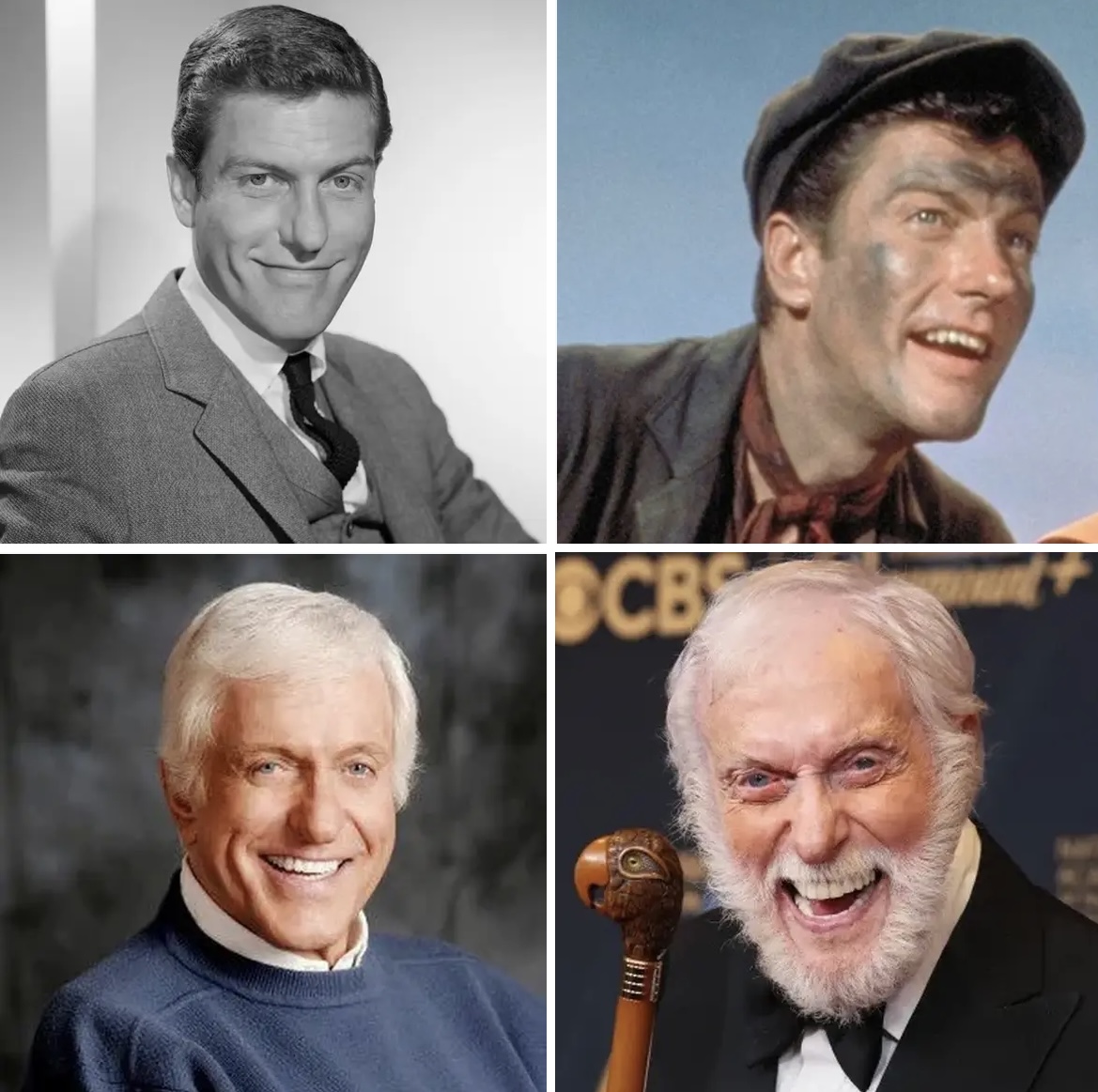
Christmas is less than two weeks away, but the title of this post may not mean what you think it means. For those too young to remember, it’s the title of a song from the soundtrack to Mary Poppins, Walt Disney’s 1964 musical adaptation of the children’s book series by P.L. Travers. The song is a duet, sung by Dame Julie Andrews in the title role and Dick Van Dyke as Mary’s pal Bert, the cockney chimney sweep.
Dick Van Dyke is celebrating a jolly holiday of a sort as he turns 100 this weekend. Born Richard Wayne Van Dyke on December 13, 1925, the Missouri native got his professional start as a radio DJ in Danville, Illinois, then transitioned to the new medium of television in the early 1950s as the host of a comedy program at a station in New Orleans. By the end of the decade, he was appearing on variety shows for the NBC and ABC television networks.
Mary Poppins was Van Dyke’s second movie (after Bye Bye Birdie in 1963). It’s been more than sixty years since he danced across the rooftops of London and plunged headlong into chalk drawings on the sidewalks below, but Bert is widely considered to be Van Dyke’s signature big-screen role.
But the small screen is a different story. He became a household name a couple years before Mary Poppins and Birdie when The Dick Van Dyke Show, a sitcom created by Carl Reiner, first aired on the CBS television network in the fall of 1961. Van Dyke played comedy writer Rob Petrie, who lived with his wife and their young son in New Rochelle, a quiet suburb of New York City.
The show became hugely popular over the course of five seasons before going off the air in 1966. It won fifteen Emmy Awards and launched the career of Mary Tyler Moore, who played Rob’s wife Laura. Veteran comedic actors Rose Marie and Morey Amsterdam played Rob’s co-writers on the staff of the fictitious TV variety program, The Alan Brady Show. Brady was played by Reiner himself.
The Dick Van Dyke Show has since become an iconic slice of television history. In 2002, TV Guide ranked it at number 13 in its list of 50 Greatest TV Shows of all Time, and on 2013, the Writers Guild of America positioned it at number 14 in its list of 101 Best Written TV Series. For more than 20 years after it went off the air, its influence was still apparent in any sitcom with a married couple at its core.
I was only two years old when the show ended its original network run. It would be another twenty years before I watched it in syndicated reruns in the summer of 1986, just after I graduated from college. WOIO Channel 19, a new independent UHF station in Cleveland, had gone on the air the year before, and its weekday afternoon programming lineup included reruns of various classic TV series. After spending my mornings and early afternoons typing cover letters, sending resumes, and engaging in various other humiliating rituals to appease the employment gods, I rewarded myself with an hour or two of nostalgic TV. The daily episode of The Dick Van Dyke Show was the highlight.
Lean, lanky and possessed of seemingly effortless song-and-dance skills, Van Dyke propelled the show’s excellent writing with a hefty dose of physical comedy. Moore brought an intriguing balance of doe-eyed naivete and sly feminine energy – and some impressive comedic chops of her own. Their onscreen chemistry was off the charts (and Van Dyke later admitted in interviews that he had a harmless crush on his young co-star).
TV sitcoms can often look pretty dated after just a decade or two, but as I watched those black and white episodes some twenty years after the fact, I was struck by how genuinely funny they still were. I suspect that I’d still feel the same way even now.
In addition to Mary Poppins and Bye Bye Birdie, Van Dyke had leading and supporting roles in other movies along the way: Chitty Chitty Bang Bang (1968), The Comic (1969), Dick Tracy (1990), two films in the Night at the Museum franchise (2006 and 2014), a charming cameo in Mary Poppins Returns (2018), and others. Critical and commercial success varied from project to project, but neither his career nor his reputation ever seemed to suffer from the occasional setbacks.
There were numerous television projects as well. The New Dick Van Dyke Show – also created by Reiner – struggled through various time-slot changes and even an overhaul of the storyline and cast before coming to an end after three seasons (1971-1974). He hosted a short-lived variety show called Van Dyke and Company in 1976, followed by an equally brief stint in 1977 as part of Carol Burnett’s comedy troupe on her long-running weekly variety show. Several years later he starred as Dr. Mark Sloan, a crime-solving physician, in Diagnosis: Murder, a franchise that started with two made-for-TV movies followed by a weekly series that ran for eight seasons (1993-2001).
Even if he never quite matched the success of Mary Poppins and The Dick Van Dyke Show in the 1960s, the guy clearly had (and has) staying power – the kind of physical and mental stamina, along with a positive attitude, that propels someone to the hundred-year mark and hopefully well past it. In a recent interview with Today Show co-host Al Roker, Van Dyke quipped that he was “looking for work” (or maybe he wasn’t joking at all) and admitted that the role he always wanted to play but never got the chance was Ebenezer Scrooge in a production of Charles Dickens’ A Christmas Carol. One wonders whether an entertainer known for such an amiable personality for so many years could have taken on such a miserable character. In the end, he probably could have. He was that versatile.
On this jolly centennial holiday, I tip my woolen chimney sweep’s cap and do a clever sidestep around the ottoman in my suburban living room in tribute to Dick Van Dyke, a showman who has reinvented himself time and again for more than seventy years.
Those of us who got to see it unfold are as lucky as lucky can be.