
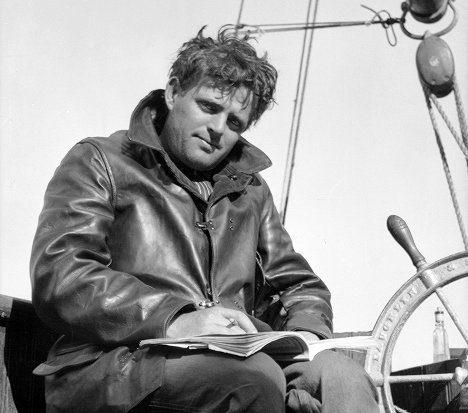
“Don’t loaf and invite inspiration. Light out after it with a club, and if you don’t get it, you will nonetheless get something that looks remarkably like it.”
—Jack London
In my generation, Jack London seemed to be a rite of passage for junior high students everywhere. Most elementary school kids in the 1970s couldn’t get through the seventh or eighth grade without reading London’s 1903 novel, The Call of the Wild.
It made sense. Teachers at that grade level typically start introducing students to long-form fiction, but many 13- or 14-year-olds find 300- or 400-page tomes overwhelming. Weighing in at roughly 33,000 words, The Call of the Wild is more a novella than a novel. Most paperback editions run barely 100 pages.
It’s the story of a domesticated dog named Buck, who is stolen from his home in California and put to work on a sled team in Alaska, where he eventually reconnects with his primitive canine instincts. The novel was actually the iceberg tip of London’s literary output in his short but prolific life. His body of work consists of 23 novels, 204 short stories and 25 works of nonfiction. Since his death in 1916, his influence on numerous writers in subsequent decades and generations has been persistent.
London was born 150 years ago this week, on January 12, 1876, in San Francisco. His mother, Flora Wellman, was a music teacher and a spiritualist. His biological father was an astrologer named William Chaney. It’s not clear whether the two were ever officially married, but Chaney essentially disappeared when he learned that Flora was pregnant.
Near the end of 1876, Flora married John London, a Civil War veteran who gave the baby his name and helped Flora raise him. After a couple more years in San Francisco, the family relocated to Oakland.
While still in his teens, London worked a variety of odd jobs: sailor, oyster pirate and power plant operator, among others. He train-hopped across America and Canada, then returned home and spent a year at the University of California in Berkeley before dropping out in 1897 to head north and join the Klondike Gold Rush. The harsh environment of the Klondike informed his later fiction, but it also resulted in health problems that would plague him for the rest of his life.
Back in California by his mid-twenties, he had developed a socialist political view and committed himself to a writing career, specifically in the rapidly expanding magazine market of the early 1900s. The Saturday Evening Post’s publication of The Call of the Wild was essentially the launch of his literary career.
In 1900, he married his first wife, Elizabeth Maddern, and the couple became part of a bohemian literary circle known as “The Crowd.” The marriage ended in 1904, and he accepted a job as a war correspondent that same year, covering the Russo-Japanese War for The San Francisco Examiner. He married his second wife, Charmian Kittredge, in 1905.
The couple bought a 1,000-acre ranch in California’s Sonoma County shortly after they were married, but despite London’s best efforts over the course of several years, he couldn’t make the ranch profitable. The failure was just part of a larger stretch of bad luck in London’s later years that also included a fire in a newly built mansion before he and Charmian even moved in.
The years before his death were marked by poor health due to various illnesses he had contracted years earlier, combined with late-stage alcoholism. He died at age forty in November 1916.
Decades after London’s death, literary critic Maxwell Geismar praised The Call of the Wild as “a beautiful prose poem.” Editor Franklin Walker said the novel “belongs on a shelf with Walden and Huckleberry Finn.” But late 20th century writer and historian Dale L. Walker maintained that “London’s true genius lay in the short form, 7,500 words and under, where the flood of images in his teeming brain and the innate power of his narrative gift were at once constrained and freed.”
Whatever the prevailing opinions about London’s relative strengths or weaknesses as a novelist versus a short story writer, I was one of those kids who read The Call of the Wild in the seventh grade, about six decades after the author’s passing. I also recall reading “To Build a Fire,” his best known short story, somewhere around that same time. Since then, I’ve read White Fang (1906), The Iron Heel (1908), and a few other short stories. It doesn’t take a Ph.D. in literature to recognize London’s visceral prose style as a direct influence on writers like George Orwell, Ernest Hemingway and Robert E. Howard.
For as memorable and influential as London’s stories are, it’s his advice about inspiration that has stuck with me the most over the years. His message is as profound as it is simple: Waiting for the creative spark is not only dilletantish but also a waste of time. You have to show up every day, put yourself in the chair and put words on the page – or the screen, or wherever – one after another, with a genuine sense of commitment. Eventually, something will take shape. And while it may not look like high art, it will have merit.
And it will motivate you to answer the call and keep going.