
Last summer I wrote in this space about my first encounter with vinyl LP recordings of the Superman radio program of the 1940s and early ‘50s. I was only about ten years old at the time of my discovery, but I’d already had an understanding what the golden age of radio was all about thanks to my father, who experienced it first-hand when he was growing up during the Depression and World War II.
If Superman was my first small step into the world of old-time radio, the Green Hornet was the next giant leap.
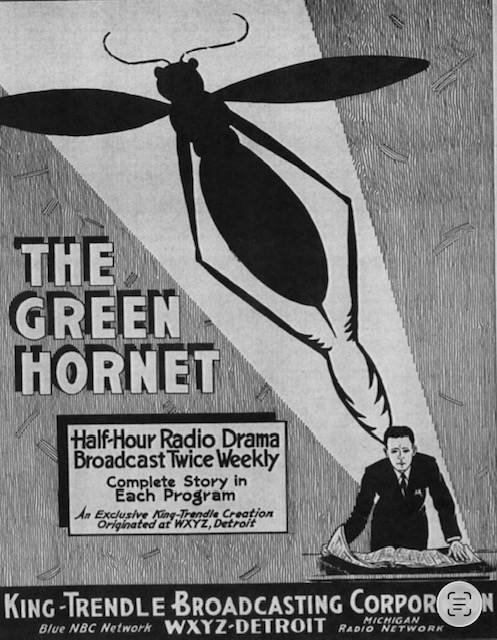
Unlike Superman, who transitioned to radio just a couple years after his first appearance in Action Comics in 1938, The Green Hornet was actually born on the airwaves. He made his first appearance ninety years ago – on January 31, 1936 – on WXYZ in Detroit. The initial broadcast marked the beginning of a radio franchise that spanned nearly 17 years and served as a launch pad for the character to expand into other media: comics, film, print fiction, television and beyond.
The Green Hornet – the character as well as the program – was the co-creation of WXYZ station owner George Trendle, writer Fran Stryker and director James Jewell. Trendle had taken ownership of WXYZ in 1930 and subsequently collaborated with Stryker to develop The Lone Ranger, which first aired on the station in 1933 (after a few trial episodes that originated from WEBR in Buffalo). The immediate success of The Lone Ranger prompted Trendle and Stryker to develop a modern-day character cut from a similar template.
Much like his 19th century masked predecessor in the Old West, The Green Hornet paradoxically worked outside the law in an effort to uphold it. But he frequently posed as an ally of underworld figures in an effort to infiltrate various criminal operations and then dismantle them from the inside.
According to the legend that Stryker built around the two characters, they were connected by more than just their similar modus operandi. They were also blood relatives. Britt Reid – the Green Hornet’s alter ego and the “daring young publisher” of the prestigious Daily Sentinel – was the grand-nephew of John Reid, a former Texas Ranger who had assumed his guise as the masked rider in the late 1800s after a group of outlaws ambushed and attacked his fellow lawmen and killed all but him.
Trendle also took the same approach to choosing the theme music for The Green Hornet as he had with The Lone Ranger. Just as the hard-driving final section of Rossini’s “William Tell Overture” had been chosen as the theme music for The Lone Ranger, Rimsky-Korsakov’s “Flight of the Bumblebee” introduced every episode of The Green Hornet. The choices were budgetary as much as anything else, as the public-domain status of both pieces of music made them easily and cheaply accessible.
Al Hodge was the first of four voice actors to play The Green Hornet on radio. Originally from Ravenna, Ohio (just fifty miles from my hometown of Cleveland), Hodge later went on to play space adventurer Captain Video in the early days of television. After Hodge’s departure from The Green Hornet in 1943, the role went to Donovan Faust, followed by Bob Hall and finally Jack McCarthy
Reid’s valet, Kato, also operated as The Green Hornet’s assistant, enforcer and all-around right-hand man. As with the Hornet, Kato was played by multiple actors over the course of the show, beginning with Tokutaro Hayashi, and later Rollon Parker, Michael Tolan and Paul Carnegie.
Kato was originally described as Japanese in the earlier stories, but that mysteriously changed for a few years during World War II, when the scripts referred to him as Filipino. His back story had changed again by the time he appeared in two cliffhanger serials produced by Universal Studios (The Green Hornet in 1940 and The Green Hornet Strikes Again! In 1941), wherein he was described as Korean. Twenty-five years later, he was portrayed on television by Bruce Lee, a Chinese-American actor and martial arts expert. When it came to ethnicity, Kato was even more mysterious than his boss.
Other regular characters included Lenore “Casey” Case, Britt Reid’s secretary in the offices of The Daily Sentinel, and Mike Axford, a former cop turned Sentinel reporter who was fiercely dedicated to hunting down and unmasking The Green Hornet. (Spoiler alert: He never managed to do it.)
Casey was played by Lenore Jewell Allmann, the director’s sister, for the show’s entire 16-year run. Actor Jim Irwin played Axford for the first two years until his death in 1938, after which Gil Shea took over the role for the remainder of the series. Over time, Axford was increasingly written to provide the stories with a comedic element.
When I was very young, I saw a couple reruns of the short-lived Green Hornet television series that originally aired from 1966 to 1967 (a subject I plan to revisit in this space later this year), but I didn’t encounter his much earlier radio iteration until many years later when I acquired some original episodes on CD. I currently own several Green Hornet CD collections, and the shelf in that corner of my library gets a little more crowded every year.
The producers aimed the program at a juvenile audience, but the storylines were usually sophisticated and compelling enough to appeal to adult listeners. Thanks to a combination of solid writing and capable acting, the dialogue rings true and the characters are convincing. John Dunning, author of On the Air: The Encyclopedia of Old-Time Radio (1998), called it “one of radio’s best known and most distinctive juvenile adventure shows.”
In almost every iteration since his initial radio broadcast in 1936, The Green Hornet has remained a consistently intriguing figure on the landscape of heroic fiction over the last century – one who operates in the shadowy space between crime and the law, but ultimately fights to uphold the latter and remains elusive enough to avoid being pinned down by either.
I say “almost every iteration” for good reason. Longtime fans of the character were initially excited in the early 2000s when Hollywood announced a big-budget Green Hornet film adaptation for the big screen, but things turned sour when news that director Michael Gondry – mostly known for his surreal comedies – was attached to the project, along with screenwriters Seth Rogen and Evan Goldberg. The casting of Rogen in the title role was the final nail. The result, released in early 2011, was a two-hour mess that critics generally dismissed and most fans resoundingly loathed.
But like many of those fans, I remain undeterred by a momentary wrong turn on Hollywood’s part. I had the good fortune of contributing a Green Hornet short story, “Bridge to Betrayal,” to an anthology published by Moonstone Books. A second story, “Diamond Girls,” is slated for a similar Moonstone volume later this year. These are just a couple small contributions to a tradition that spans various media and stretches all the way back to the golden age of radio, but they are nonetheless a source of pride.
Ninety years after his first appearance on the mean streets in the theater of the mind, The Green Hornet is alive and well – still battling the underworld, and still at large.