
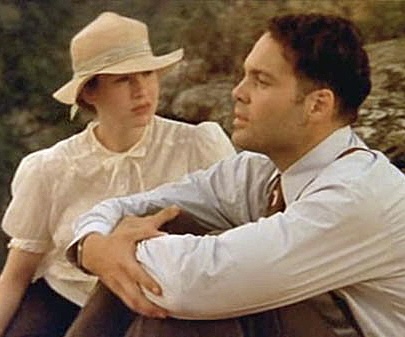
In November of 1996, I went to a movie theater somewhere in the east suburbs of Cleveland with a few friends to see a newly released film called The English Patient, directed by Anthony Minghella and starring Ralph Fiennes, Juliet Binoche, Willem Dafoe and Kristin Scott Thomas. The experience was unforgettable – for reasons that had nothing to do with The English Patient.
Don’t get me wrong. It’s a fine film. The critics loved it, and it performed well at the box office. It received a dozen Academy Award nominations and won nine. I watched it again years later and enjoyed every minute. But I honestly have no memory of that first viewing in that theater in November of 1996, because I was completely distracted for the duration of the film – more than two-and-a-half hours – by a two-minute trailer that had played before it even started.
The trailer was for an independent film called The Whole Wide World, directed by Dan Ireland and based on a memoir called One Who Walked Alone, by Novalyne Price Ellis. Those two minutes stayed with me for weeks, until the film itself opened in theaters a month later. I went back to the same movie house by myself and watched The Whole Wide World in its entirety.
It’s the story of Robert E. Howard, the pulp writer of the 1930s who created Conan the Barbarian (“the damnedest bastard there ever was…”) and a host of other swashbuckling fantasy heroes, including Solomon Kane, Kull of Atlantis and Bran Mak Morn. Ms. Ellis, who was just Novalyne Price at the time the story takes place, is a 26-year-old schoolteacher in Cross Plains, Texas, and an aspiring writer who approaches Howard for advice about the craft.
A romance develops between the two, but despite their mutual respect, the relationship falls apart due to their inherent differences. She’s a proper young woman embarking on a respectable teaching career. He’s an unpolished misfit, living in his parents’ house, enmeshed with his ailing mother, devoid of any substantive relationship with his father, and grinding out stories for Weird Tales and other fantasy and horror fiction magazines of the day. As couples go, the two are practically doomed from the start.
Howard is played brilliantly by Vincent D’Onofrio – full of bravado to cover up a social awkwardness and an inner turmoil that surfaces tragically in the movie’s final act. Renee Zelleweger plays Novalyne Price, not much more than half D’Onofrio’s size but full of grit and never afraid to go toe-to-toe with her blustery suitor and put him in his place when necessary.
On more than one occasion throughout the film, Howard or one of the supporting characters hyperbolically proclaims him “the greatest pulp writer in the whole world.” Before the story ends, Novalyne – strangely smitten by this odd creature yet heartbroken by the star-crossed nature of their relationship – is fairly convinced that the claim might actually be accurate.
If not the greatest, Howard was at least prolific, considering that he wrote professionally for only a dozen years. Exact tallies vary from one historian to another, but his career output of short stories and poems numbers well into the hundreds. Ninety years after the writer’s death, Conan and his adventures endure via reprints of Howard’s original stories published in the 1930s, as well as novels and short stories by other writers in the subsequent decades. The character has also appeared in comics, on the big screen and on television. A century after the start of his literary career, Howard is considered the godfather of a subgenre of fantasy fiction that is today known as sword and sorcery.
The Whole Wide World had actually premiered ten months before I saw that two-minute trailer, at the Sundance Film Festival in January 1996. Although it probably wasn’t intentional, the release of the film in 1996 marked the two anniversaries that bookended Howard’s life. He was born January 22, 1906, in Peaster, Texas, and he died by suicide at age 30 on June 11, 1936, in Cross Plains.
I had only a minimal knowledge of Howard before I saw the film. I knew he was the creator of Conan, and I knew he had ended his own life at a young age, and that was about all I knew. In the thirty years since, I’ve familiarized myself with a fair amount of his work. The Conan stories in particular are set in a mythical Hyborian Age, populated with sword-wielding adventurers, wizards and dark priests, dragons and demons, and shapely seductresses who may or may not be witches. Through it all, Howard’s writing is visceral and compelling. One needn’t be a hardcore fan of sword and sorcery fiction to recognize and respect his skills as a storyteller. To date, I’ve read at least a half-dozen volumes of his collected works. Another half-dozen are still waiting in my library.
Some historians and Howard enthusiasts have speculated over the years that he may have suffered from some form of clinical depression or even bipolar disorder. His contentious personality, the dark nature of his work, and the tragic circumstances of his death would support such theories, but mental illness was a taboo subject in the 1930s – and as such, rarely addressed. We’ll never know for sure.
Regardless, I find Howard’s commitment to his craft inspiring. He was a misfit who followed his creative instincts, refused to listen to the naysayers, and refused to conform. He was a storyteller who shook a defiant fist at the world around him and at the same time waged a mighty struggle against the demons lurking in the world inside of him.
It’s not for me to say whether he was the greatest pulp writer in the whole wide world, but in a literary landscape confined to the first half of the 20th century and littered with obscure and forgotten writers, his name and his legacy endure.