
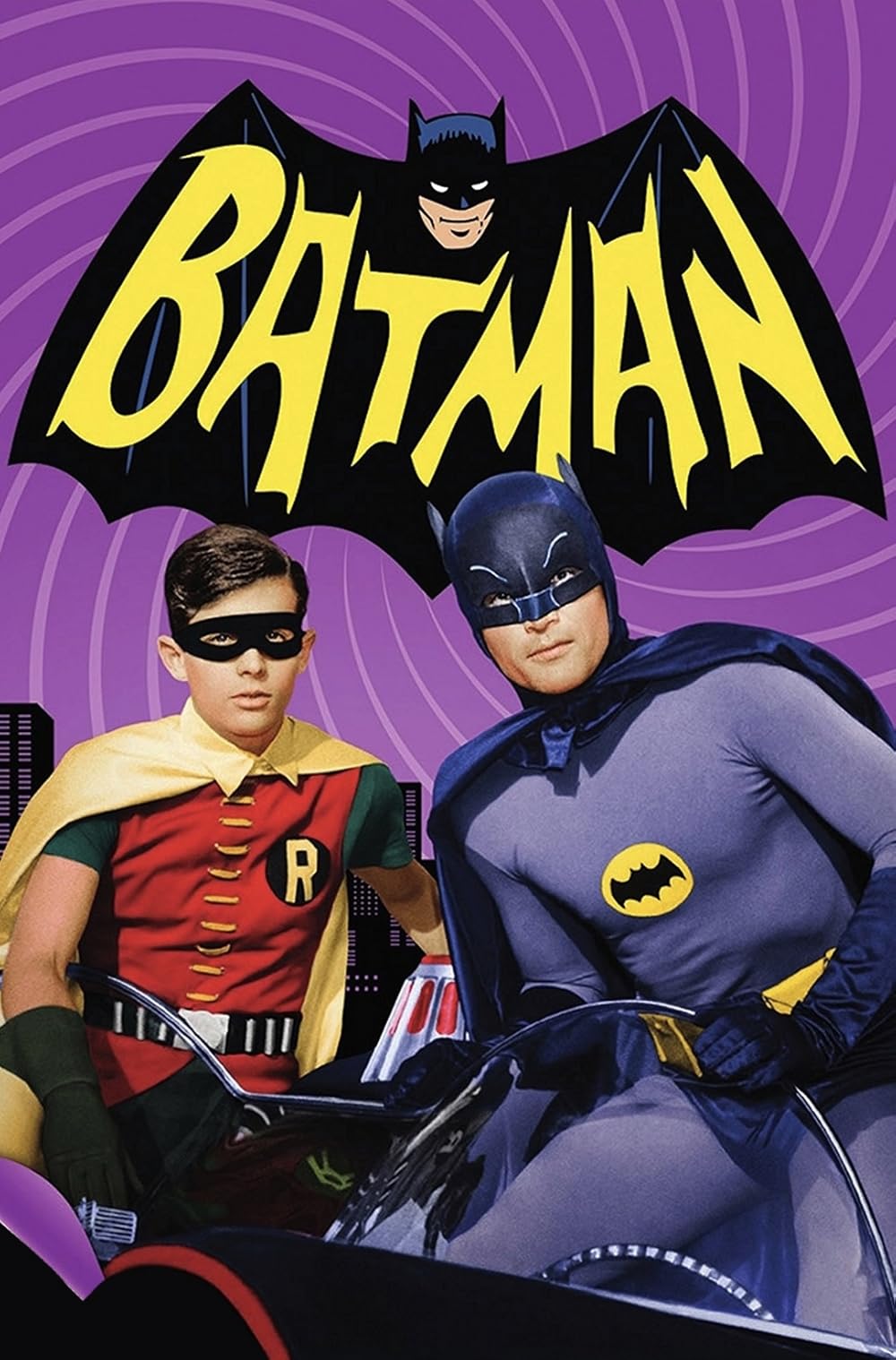
What happens when you take a crime-fighting detective with a decidedly gothic fashion sensibility from the pages of mainstream American comic books and filter him through the high-camp, pop-art zeitgeist of the mid 1960s? The answer is a prime-time TV phenomenon called Batman.
For the last forty years, the Caped Crusader has been portrayed in comics and on the big screen as a grim, slightly obsessive figure of the night who brings a razor-sharp intelligence, an arsenal of high-tech gear and a generous dose of childhood trauma to his neverending war on crime in his native Gotham City.
But for those of us from an earlier time, there was a different kind of Batman before all that, one who dominated the small screen for a short time in the mid- to late 1960s. He and his teenage sidekick – Robin, the Boy Wonder – swung into American living rooms for the first time sixty years ago tonight, on the evening of January 12, 1966. Over the course of three seasons and 120 episodes in his original primetime run on the ABC network, followed by his reappearance in syndicated reruns during the 1970s, this Batman was something far less grim and obsessive. He was something much brighter and more tongue-in-cheek.
This Batman was something else.
There’s not much I can say about Batman ‘66 (as the series is frequently called) that hasn’t already been said. Hell, entire books have been written about it. I know because I contributed an essay to one such volume published by Becky Books in 2021.
Actor Adam West in the title role understood the comedic power of adopting an earnest, deadpan persona in an otherwise absurd fictional universe. Burt Ward – a young actor barely into his twenties at the time – played Robin with a boyish, hyper-enthusiastic energy that served as a counterbalance to West’s deadly serious delivery.
Together they cruised around Gotham City in a sleek, wicked-cool car that they stored in their subterranean lair underneath the mansion of Bruce Wayne, Batman’s millionaire playboy alter ego. They maintained an endless array of clever gadgets, which they deployed against a rogue’s gallery of arch villains played by veteran A-list actors like Cesar Romero (the Joker), Burgess Meredith (the Penguin) and the alluring Julie Newman (Catwoman).
At least once every episode, the Dynamic Duo confronted these and other foes (and their generally brainless henchmen) in a burst of intense and highly choreographed hand-to-hand combat fueled by an uptempo musical score and punctuated by sound effects that splashed across the television screen.
And just in case they needed a helping hand after a couple years of all the craziness, they gained an unexpected female ally in the third season when Batgirl — who was in real life the daughter of Police Commissioner Gordon — rolled up on her pastel purple motorcycle. Batgirl, played by Yvonne Craig, further ratcheted up the sex appeal generated by Newmar during the first two seasons.
And that infectious opening theme music. A churning 12-bar piece composed by jazzman Neal Hefti, with a recurring single-word lyric that’s as easy to remember as the title of the show itself.
The entire experience was wacky and sly and irreverent and just plain bonkers, and for a time, American TV viewers — the young and the old, each for different reasons — fell into a feverish wave of Batmania.
January was an odd time of year to launch a new television series, but the network had premiered several new shows in the fall of 1965 that were pulling weak ratings by the end of the year. Batman had been scheduled for a premiere in the fall of 1966, but ABC programmers moved up the timetable in an effort to shore up their Wednesday night lineup.
But rather than air the hour-long premiere in its entirety, the episode was cut in half – at a cliffhanger moment, conveniently enough – and the second half aired the following night: “Same Bat-time, same Bat-channel…” according to narrator William Dozier, who was also the producer of the series. (By all reports, Dozier had never looked at a comic book in his life before putting Batman on the air). The show was an immediate hit, and this twice-a-week schedule became the standard format for the series for the remainder of its first season and all of its second.
I had just turned two a few weeks before that first episode aired. I don’t know what my perception of television in general would have been in that formative period of my life, but I’ve been told that I was hooked on the show by the time it got into its second and third seasons. In the years before I could read, I would beg my older sister to recite the sound effects during the fight sequences. She begrudgingly accommodated me. At no time in the history of older siblings were words like “Sock!” “Pow!” and “Splat!” delivered in such a bored monotone.
My devotion to Batman ’66 continued well into the after-school rerun era of the early to mid-1970s. And while I may feel like I’ve outgrown this particular version, I still appreciate it as a product of its time and an important piece of the character’s much larger 87-year history. This Batman was fun, he was memorable, and he left a mark. And yeah, I’d still give anything to get behind the wheel of that car.
Sometime before this day is over, I‘ll keep one eye on the empty space in my living room on the outside chance that the sounds of an all-out brawl might flash before my eyes in bold letters. (I’ll have no trouble reading them myself this time.) And I’ll check the instrumentation on the dashboard of my generic Honda Civic to make sure the atomic batteries are once again up to power and the turbines are up to speed.
Holy anniversary. Ready to move out…