
I’m not sure exactly how I discovered Archie Andrews in the late 1960s. The fact that I was already a fan of Saturday morning cartoons, comic books and the comics section of my local newspaper probably had something to do with it. Archie and his pals were in all three of those places. And for a few months in the latter half of 1969, he was on the radio too.
The all-American kid from Riverdale had already been around for nearly thirty years by that time. He’d made his first appearance in issue #22 of Pep Comics, which hit the newsstands in October 1941. John Goldwater, co-founder and publisher of the entity then known as MLJ Comics, envisioned Archie as an alternative to the army of superheroes who had taken over the comic book market by the early 1940s. Goldwater believed that a regular teenager – someone like the fictional Andy Hardy, portrayed in movies by actor Mickey Rooney – could be just as entertaining as Superman, Batman, Captain Marvel or any of the rest.
Archie caught on, well enough to carve out his own respectable corner of the landscape. He graduated from the pages of Pep about a year later and reappeared in the first issue of his own magazine, Archie Comics, at the end of 1942. From there, he hummed along steadily for a couple decades.
In the late ‘60s, he and his pals became hot property. In 1967, Filmation Studios cut a deal with Goldwater to produce The Archie Show (aka The Archies), a series of half-hour animated episodes for the CBS television network’s Saturday morning lineup.
This is where I came in.
Given the runaway success of The Monkees, who were starting the second and final season of their weekly primetime series on the NBC network at that time, every half-hour episode of The Archie Show followed a similar format – a funny story punctuated by a musical segment that resembled the zany, often absurd romp that The Monkees would embark on against the backdrop of one of their songs. (This fusion of music and video was sort of a precursor to the content that would run 24/7 on MTV about a dozen years later.)
The musical numbers for The Archie Show were produced by Don Kirshner, who had helped launch The Monkees a year earlier, and sung by Ron Dante and Toni Wine. (Archie’s spoken dialogue in the animated episodes was provided by voice actor Dallas McKennon).
The Archies, although completely fictional, became a musical entity of their own, releasing a series of singles on Kirshner’s Calendar Records label, with Dante and Wine backed by studio musicians. In 1969, songwriters Jeff Barry and Andy Kim wrote a song for the “group” called “Sugar, Sugar.” Released as a single in May, “Sugar, Sugar” climbed to the top of the Billboard Hot 100 in September and stayed there for four weeks. It was the number one song of 1969 in the U.S. and UK.
It was all great fun when I was five or six years old. I remember listening to the Hot 100 Countdown on my GE transistor radio at the end of the year (probably on Cleveland’s WIXY 1260 AM) and waiting for the crew of goofy teenagers whom I’d been watching on TV every Saturday morning to sing their catchy, 2:45 bit of bubblegum pop. I did wonder a little bit how a group of animated characters landed a record deal that got them to the top of the charts, but I was way too young to ask a lot of questions about the machinations of the record business. I just enjoyed the ride.
But apart from the music, there was something about Archie that did puzzle me as I got into my teenage years – and it puzzles me to this day.
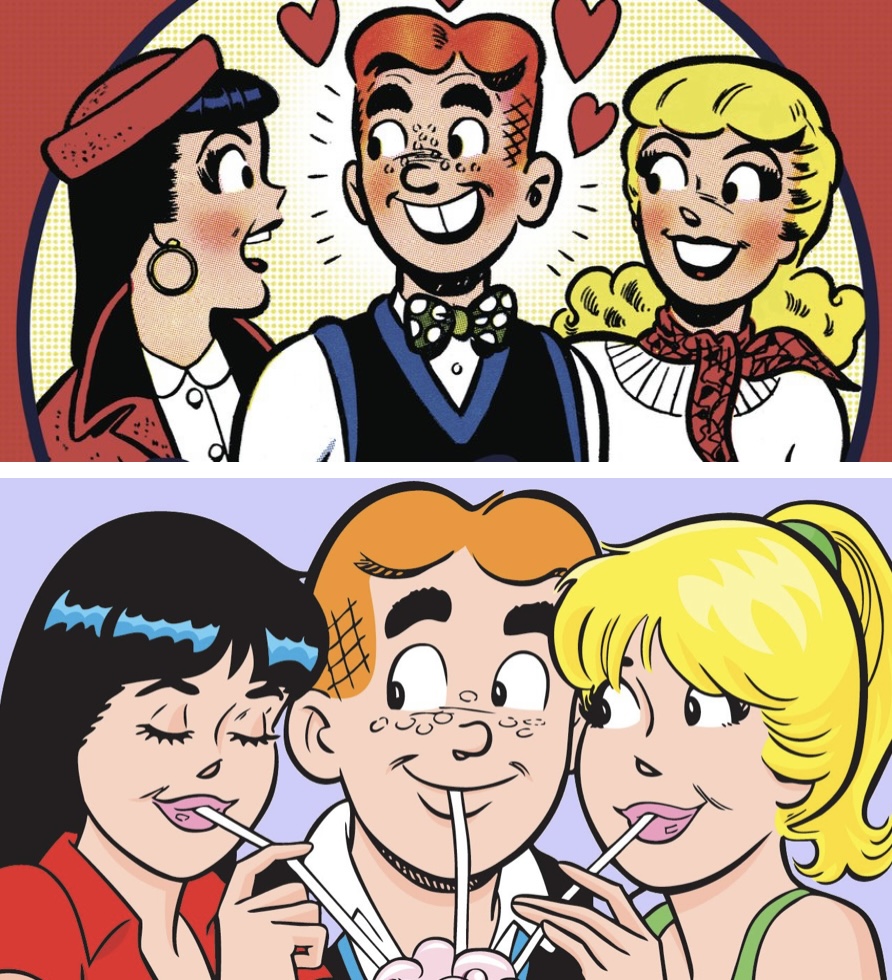
Anyone with even a passing familiarity with Archie over the years knew his story. Not unlike a lot of 17-year-old boys, he was kind of girl-crazy, but I always thought there was something much more sly going on that belied his young age. As it turned out, he was a serious playa – a chick magnet, if you will – and he continues to be so in his 85th year at Riverdale High School.
He consistently found himself in the middle of a weird romantic triangle, and he seemed perfectly happy to be there. On one hand was Veronica, raven-haired and well-heeled, and oftentimes aloof and indifferent to Archie’s advances – until some other girl paid attention to him, at which time she would inevitably get very territorial.
Some other girl was usually Betty Cooper, blonde-haired, fun and fun-loving, the ultimate girl next door. Betty made her affection for Archie pretty clear, but somehow her availability made her less attractive in his eyes. For Archie, Veronica was the prize. Betty always seemed like his Plan B.
And yet, in some twisted way, Betty and Veronica were best friends. They hung out together all the time, often dishing the dirt about Archie and sometimes hatching a plot to force him off the fence and into some kind of commitment to one or the other of them. The pair even had their own magazine in the Archie Comics line for many years – a monthly collection of stories that featured the two girls in various (mis)adventures that may or may not have included Archie, Jughead, Reggie, or any of the other Riverdale boys in supporting roles.
Archie has managed to play this game with Betty and Veronica to his advantage for more than eight decades – so much so that, based on what we learned from the lyrics in the backing vocals on “Sugar, Sugar,” both of these young ladies maintained a standing offer to make Archie’s life so sweet. Exactly how they planned to do that was never made clear in the song. Perhaps it’s best not to ask.
I mean, he always seemed like a nice guy and all. And it’s good to know that – in some alternate universe, at least – the cute girls go for the nice guy. But come on. Have you seen this kid? Wavy red hair and freckles? In the world I lived in when I was seventeen, girls didn’t gravitate to the boy with the wavy red hair and freckles.
Trust me, I know. Because when I was in high school, I was the boy with the wavy red hair and freckles. Granted, I attended an all-boys high school, but I knew plenty of girls – blonde, brunette and otherwise – on both sides of Cleveland. I don’t recall any of them pursuing me very aggressively. I’m not even sure if I recall any of them giving me the time of day.
What do the kids call it these days? Rizz? Archie had it, and he leveraged it for 85 years – and while I haven’t picked up any of his comic books in more than fifty of those years, I have it on good authority that he’s still doing it. And he’s still getting away with it.
I knew none of this when I was five or six, reading about Archie in his comic books or his newspaper strip, or tuning into the hijinks every Saturday morning, or catching him my transistor radio. Had I known what was possible in the seemingly quiet little town of Riverdale, I might have lobbied my parents to move us there before my teenage years and enroll me in the public high school.
Archie Andrews, you smooth devil. I gotta hand it to you. Not only do you still have the wavy red hair and freckles after 85 years, but you still have some serious game.
A life so sweet, indeed.