
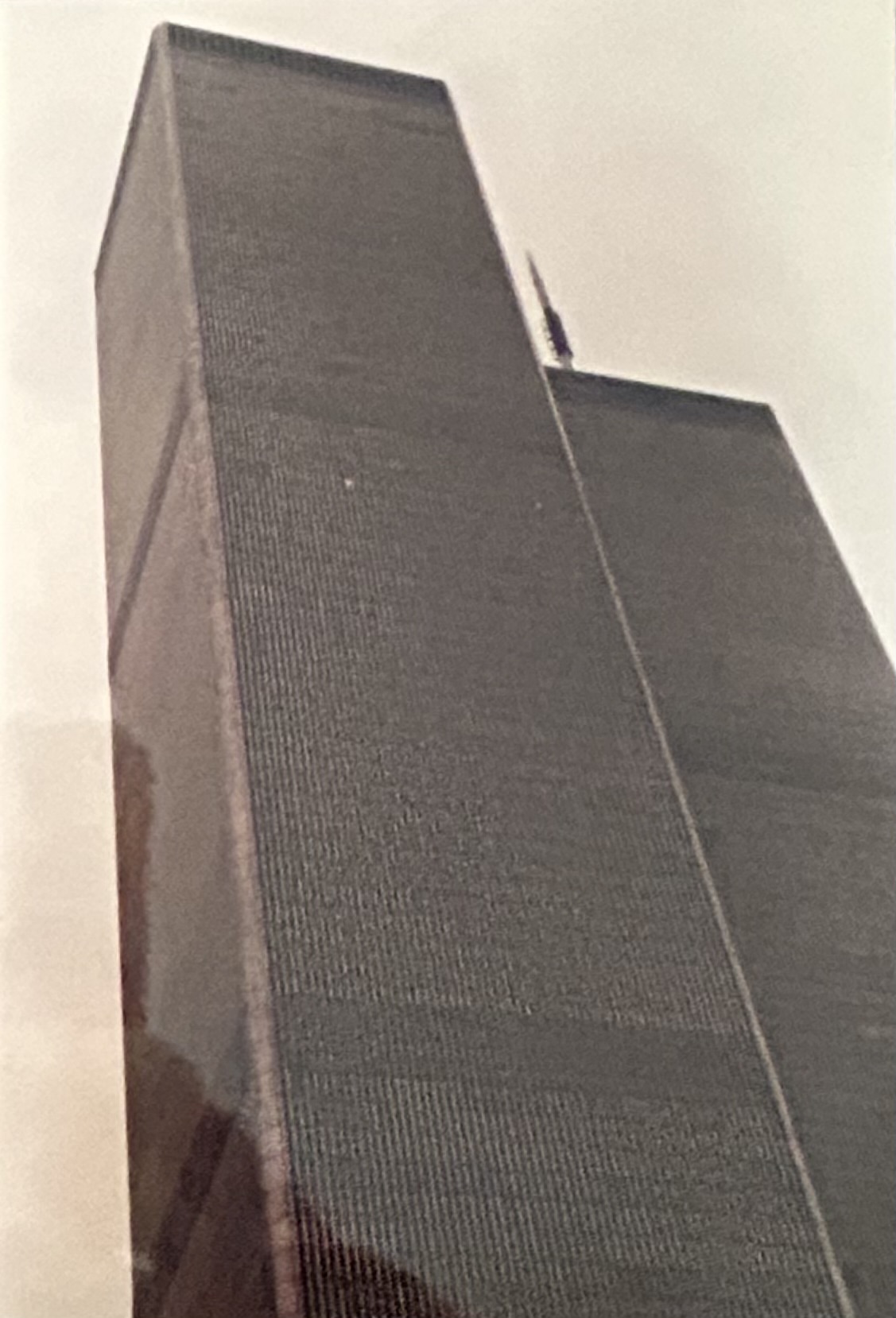
I took the photo at left during a trip to New York City in the summer of 1986. I was 22 years old at the time, fresh out of college. I had no plan, no idea how my life would turn out. I was just walking around NYC with my new Nikon N2000, a graduation gift from my parents.
It should be glaringly obvious from this image that I was not a professional photographer. I was just a kid, an annoying tourist from Ohio with a camera around his neck, taking pictures of everything and anything during his first trip to The Big Apple.
From a strictly aesthetic standpoint, the two adjacent skyscrapers collectively known as the World Trade Center were actually pretty boring to look at. Two silver and gray rectangles of the same size and shape, functional but far from ornate.
But at nearly fourteen-hundred feet in height, they were the tallest structures in New York City. They were enormous, monolithic, and seemingly eternal—like Stonehenge, or the Sphinx. They were the hub of international commerce on this side of the Atlantic Ocean, and they had become almost as iconic on the New York skyline as the Empire State Building or even the Statue of Liberty.
The photo was one of many from the trip, taken in a time long before the immediacy of cell phone cameras. I brought my rolls of film home from New York, got them developed, tucked my memories into an album, and got on with my life. I went back through the photos occasionally over the years, but not often.
Fifteen years after that trip, in the late summer of 2001, I was working in the marketing department of an independent record label in Cleveland. Everything was new then. I had been married for less than two years. I had just taken the marketing job a few months earlier, after fifteen years as a journalist. My wife and I had just bought our first house the year before, and she was spending her days at home with our eight-week-old daughter.
My job required that I stay in regular contact with two publicists who operated out of satellite offices, one in Nashville and the other in New York. On the morning of September 11, 2001, I was on the phone with Valerie in Nashville. She told me she had just seen something on her TV about a plane slamming into one of the towers of the World Trade Center. She said the details were sketchy, but she was keeping an eye on it.
At the time, it sounded like a really bad case of pilot error. Because the idea that it could be something deliberate was unthinkable. Whatever the case, Valerie and I finished our usual business and got off the phone.
She called back about ten minutes later, and this time her voice was shaking. She said a second plane had just gone into the other tower. I remember a sick feeling in the pit of my stomach.
I started thinking about the unthinkable.
I hesitated to end the call with Valerie, because she sounded pretty agitated, but I heard people gathering in the hallway outside my office and I wanted to find out what was going on.
It was, in fact, the unthinkable: a terrorist attack. Two hijacked commercial airliners aimed at the two towers. A third at the Pentagon. (I later spoke with Mike, the New York publicist, who said he could see dust and smoke all day long from the window of his house in Queens.)
We all spent the next hour or two of that morning huddled around a TV in a conference room at the end of the hallway, trying to make sense of the senseless. At one point, an admin came into the room and said there were reports of a fourth hijacked plane over Cleveland, which struck me as odd—and maybe a little dubious, because everything we were seeing on TV was about New York and Washington.
As it turned out, she was right. The fourth plane had flown as far west as Cleveland metropolitan airspace before turning and heading back east. We later learned that the passengers had overtaken the hijackers and forced a crash landing in an open field in rural Pennsylvania.
By lunchtime, the head of the company recognized that nothing was getting done that day, and nothing was going to get done. He graciously sent us all home.
I went home to my new wife and our new baby in our new house. I was 37 years old and I was profoundly aware that I had no fucking idea how to protect them from an angry, random, miserable, chaotic world. I don’t think I ever felt more powerless in my life.
A couple days later I learned that a member of my high school class had been in one of the towers during the attack. His name was Joe. He was somebody I sat next to in tenth-grade geometry some twenty years earlier. We weren’t close friends by any means, but we helped each other muddle through the often-baffling material. I hadn’t spoken to Joe in decades, but for two semesters once upon a time, we had been allies of a sort.
It’s been twenty-five years since the 9/11 attack. For better or for worse—and I think I know which—the event pretty much set the tone for the 21st century.
I dug this photo out of the album last night. For as badly composed and boring as it looks, I stared at it for a long time. I thought about everything that has come and gone since that weekend in 1986 when I wandered around New York City with my new camera. At the time, the world felt wide open and full of possibilities.
I thought about that Tuesday morning in September 2001, and all the fear and grief and uncertainty that hung over all of us for the next several weeks and months—and years. I thought about our eight-week-old baby, who is now in her first year of graduate school—and her younger brother, our son, who just graduated from college this past spring.
I thought about the nearly three-thousand people who lost their lives that day, including a 37-year-old commodities broker who had struggled through high school geometry years earlier, and the thousands more whose lives were forever changed in the aftermath.
Even in the best of times—and these are not exactly the best of times—we live in an uncertain world. Some days it feels just as angry, random, miserable and chaotic as it did twenty-five years ago. And some days I feel just as powerless as I did then.
So I make a choice every day, if for no other reason than to preserve my own sanity. I look to the quieter places, away from the cameras and microphones and podiums and pulpits and platforms. I watch for the small and random acts of kindness, and I try to commit as many of my own as I can. I look for the momentary gestures of compassion and shared humanity, especially the ones that happen between strangers who have absolutely nothing to gain from their actions. I look to the artists and the musicians and the storytellers—the well-known and the obscure—who do their best to tap into a higher power and bring something beautiful and enduring into the world. I look for the helpers.
I still choose to believe in the assertion by a wise man of an earlier generation that human history is shaped each time an individual stands up for an ideal or acts to improve the lot of others or strikes out against injustice. I still believe in the tiny ripples of hope that many of us generate every day until they eventually converge into a powerful current that can bring about profound changes and make a better world.
These are the things I hold onto a quarter of a century later.