
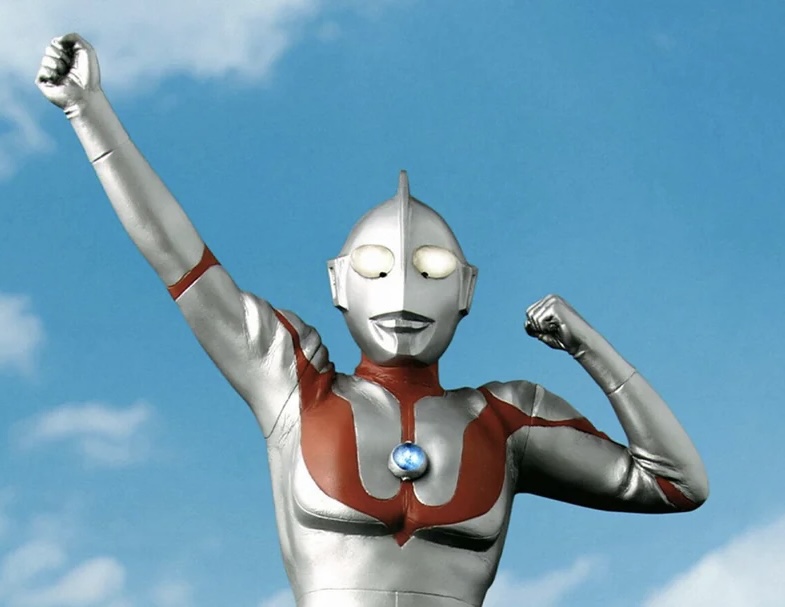
My first encounter with Ultraman was sometime in 1969, when I was still in kindergarten.
It was one of my classmates, a boy named Mike, who tipped me off. Mike lived on my street, and he had an older brother – a worldly wise fifth grader – who was dialed in to the best TV shows and movies and toys of the day. This gave Mike the inside track on everything that was cool – whatever cool means when you’re five or six years old.
Mike gave me the low-down on Ultraman, a show that aired every day after school on the local UHF independent station (WUAB Channel 43). I seem to recall four o’clock being the start time. The premise, as he explained it, was simple but fascinating: A giant man from outer space comes to earth in every episode and fights equally giant monsters.
Mind you, I had already been mainlining animated episodes of The New Adventures of Superman every Saturday morning for at least a year or two by this time. My discovery of those eight-minute gems produced by Filmation Studios goes back to a time that I can’t even remember anymore.
This Ultraman sounded like a variation on the Superman theme. A much taller variation. I was intrigued.
The quick backstory on the show goes like this: Ultraman – better known as Urutoraman in his country of origin – was created for Japanese television by filmmaker and special effects engineer Eiji Tsuburaya (1901-1970). Tsuburaya had been part of the team that created Godzilla, the iconic reptilian beast that made its first film appearance in Japanese theaters in 1954.
Ultraman was a member of a race of 130-foot-tall intergalactic beings from a place called Nebula M78. They were committed to protecting the earth and other worlds from any and all forms of kaiju – the Japanese term that loosely translates to “giant monsters.” In the premiere episode, the big guy arrives on earth to neutralize one such threat, but Shin Hayata, a member of a paramilitary civil defense group called the Science Patrol, is accidentally killed in the altercation.
Compassionate cosmic super-being that he is, Ultraman offers to resurrect the ill-fated Hayata in that first episode by sharing his life force with him. As part of the bargain, Hayata agrees to carry a gadget called the beta capsule with him at all times. Activating the capsule will summon Ultraman from the skies whenever the earth is threatened – usually by a giant monster, which seems to happen quite often in Tokyo and elsewhere in the Land of the Rising Sun.
He made his first appearance on Japanese television sixty years ago this week, on July 17, 1966. Two months later, United Artists Television in the U.S. picked up the rights to air episodes dubbed in English. By the end of the year, Ultraman was appearing on independent stations all over the country.
The adversaries came from everywhere – under the sea, under the earth, outer space or entirely different dimensions. And they were bizarre as hell. There was Dada, a bipedal alien invader – sometimes human-sized, other times enormous – with body markings like a zebra and face and hair that resembled a latter-day Michael Jackson after his countless plastic surgeries. And there was Jamila, a former Japanese astronaut who mutated to monstrous proportions in order to survive on an alien planet, then returned to Earth on a mission of vengeance.
Jirass was a particularly interesting entry in Ultraman’s rogue’s gallery. His exterior was nothing more than a Godzilla suit repurposed with a collar that looked like – wait for it – an enormous leaf of lettuce. When Ultraman tears off Jirass’s collar in the first minute or two of fighting, the ruse is suddenly exposed, and Ultraman proceeds to go toe-to-toe with a de-accessorized version of the infamous King of All Monsters.
When any one of these or other towering menaces appeared, the Science Patrol would make their usual valiant effort to destroy them, but inevitably they’d fall short. In the moment when things seemed most dire, Hayata would reach into his jacket, pull out his secret device, raise it over his head and trigger the transformation.
“Using the beta capsule,” the narrator would intone, “Hayata becomes..Ultraman!”
While he usually seemed quite capable of managing any threat, Ultraman did have a handicap. Something about the earth’s atmosphere placed certain limitations on his endurance, so he needed to wrap things up quickly once he arrived. A warning light on his chest would inevitably start flashing when his power was reaching its limit. “Should the warning light go out,” the narrator explained in every episode, “Ultraman will never rise again.”
As you might expect, he vanquished his foe every time. His signature move, the one that usually closed the deal, was something called the specium beam – a high-powered blast of energy that emanated from the edge of his hand when he crossed his wrists. In the parlance of boxing and street fighting, the specium beam was the finisher.
Except for that time when it wasn’t. In the final installment of the series’ 39-episode run, an exceptionally tenacious beast known as Zetton executed a counterstrike against every one of Ultraman’s offensive maneuvers. After a few tense moments, Ultraman’s warning light went dark, his body stiffened and swayed, and he toppled to the ground like a giant statue.
I remember being frightened by this. That whole “Ultraman will never rise again” business that we’d been hearing about all along seemed pretty ominous to me. (Hey, come on. I was only five or six at the time.)
But as it turned out, our hero was merely lying in a subconscious state. When his commanding officer arrived to gather him up, Ultraman cut a deal to give his life force back to Hayata before returning to the home planet. The dialogue in the English-dubbed version suggested that he was just going back for repairs, but I learned years later that the original Japanese dialogue clearly stated that the battle with Zetton was Ultraman’s last hurrah.
(Fortunately, the Science Patrol came up with a weapon powerful enough to destroy Zetton while Ultraman was in his compromised state. But it begs the question: would they have needed an intergalactic savior in the first place if they’d designed and built more effective tech from the get-go?)
Ultraman as a pop-culture phenomenon has enjoyed a much longer run than the original 39 episodes. Tsuburaya Productions has generated thirty subsequent Ultraman series (so far) since the 1960s, each one featuring a variation of the original character. To the best of my knowledge, none of these later iterations have made it to American TV, but back home over the span of sixty years, Ultraman has essentially become Japan’s version of Superman.
Last fall I dialed up Shin Ultraman on one of the streaming platforms. Directed by Shinji Higuchi and released in Japan in 2022 (and the U.S. in 2023), it’s a feature-length homage to the original Ultraman series. I had to rely on rapid-fire subtitles rather than English dubbing to follow the dialogue and the story, but I caught the general idea. The modern-day version of the Science Patrol – a group called the S-Class Species Suppression Protocol – had a more youthful vibe (or maybe it just seemed that way because I’m a hell of a lot older now than I was in 1969), and the movie’s visual effects were lightyears beyond the rubber suits and other primitive practical effects of the pre-CGI era.
I was pleasantly surprised at how much I enjoyed seeing him again after so many years. I’m still partial to the home-grown and more human-sized do-gooders that I’ve followed in animation, comics and live-action film for most of my life, but I’ll always have a soft spot for the silver giant from Nebula M78.
Sixty years and several hundred kaiju later, he’s still pretty cool.
# # #
(Ultraman was one of many adventure-themed TV series produced for juvenile audiences in Japan in the 1960s and ‘70s and exported to the U.S. and other international markets. For more about programming from that era, check out Rising Sun Reruns: Memories of Japanese TV Shows from Today’s Grown-Up Kids, published by Becky Books. The collection includes a variation on the essay above, along with contributions by several other writers.)